Think & Discuss
Quick Check
Inquiry Task
In support of the progress narrative: settlement, granaries, irrigation, and rising population density indicate increased food production and organizational capacity. Constraining factors: declining average height, dental disease, and repetitive strain suggest that individual health and labor burdens may have worsened. Therefore, the species/group scale must be distinguished from the individual scale; population growth alone cannot prove that individuals were happier. We should also avoid applying violent-trauma evidence with high regional variation as a universal conclusion.
We need to observe whether early agriculture improved food reliability, whether population grew afterward, whether investment in land and storage increased, and whether the cost of reverting to foraging or migrating rose. Institutional factors such as environmental fluctuations, taxation/land rent, and social stratification must also be considered. If the evidence shows that groups found it hard to exit and that individual well-being did not improve in step, the luxury trap is supported; otherwise, it needs revision.
The common progress narrative frames the Agricultural Revolution as a great triumph of human intelligence: settlement, food surpluses, civilization, the state, and a "higher" way of life all seem to begin with this step.
But this narrative presupposesteleology: as if history were heading toward agriculture, cities, and empires from the very start.
In Sapiens, Harari argues that agriculture was not a sudden leap actively chosen by humans, but a slow transformation unfolding over thousands of years. From around 9000 BCE, agriculture emergedindependentlyin regions such as West Asia, East Asia, Mesoamerica, and the Andes—not as diffusion from a single Middle Eastern point of origin.
The so-called "biggest fraud in history" is not a conspiracy theory, buta mismatch of evaluation scales: evolutionary success of the species—population growth, DNA replication, expansion of power—does not equal greater happiness for individual farmers. Species success and individual happiness must be measured separately.
The luxury trapexplains why turning back was so difficult: early agriculture seemed to improve food reliability, but subsequent population growth, land dependence, and investment in storage and institutions made reverting to foraging extremely costly; at each step, there was no going back.
Agriculture increased yields per unit of land, but brought with it a narrower diet, infectious disease, physical strain, vulnerability to drought and flood, and exploitation through taxation and land rent. Settlement also gave rise to private property, the state, writing, organized religion, and social stratification, creating path dependence—agriculture was not only an economic choice but also a cultural lock-in.
A caution on boundaries: evidence of violence and trauma in archaeological remains varies greatly by region, and the foraging era was no Eden; but "foragers were imperfect" does not imply "agriculture was progress." The focus remains on the shift of scales and the test of individual well-being.
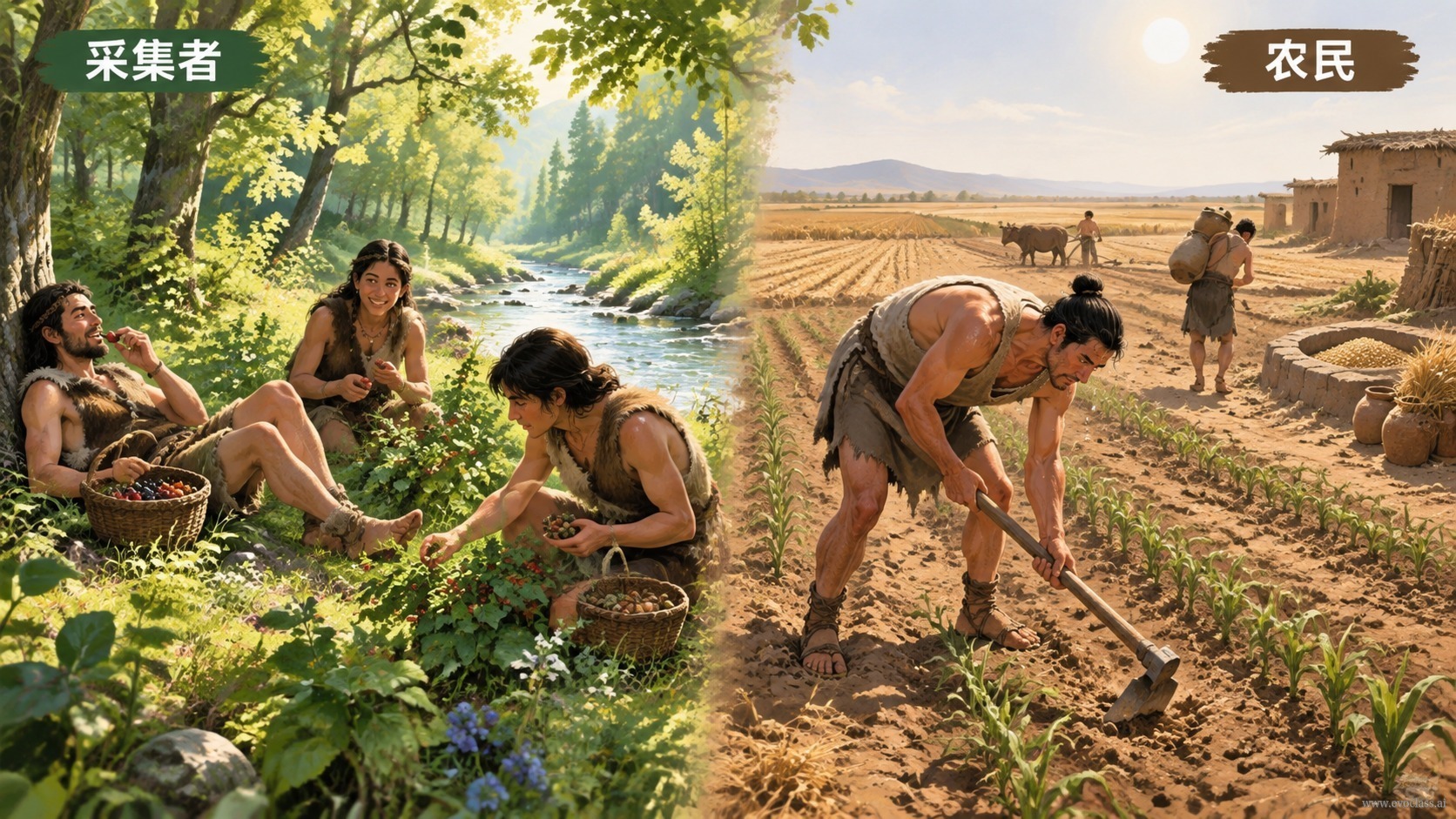
Side-by-side contrast: foragers ate a varied diet, worked in intermittent bursts, and moved with the seasons; farmers bent over the wheat/rice/maize cycle, weeded, irrigated, and stored grain, and faced threats from drought, flood, pests, taxation, and land rent. The former was not necessarily perfect, yet the latter was not necessarily happier.
A comparison image: foragers gathering at leisure alongside farmers bent over in laborObserve the comparison image: foragers gathering at leisure are shown alongside farmers bent over in labor. What stands out to you?